Refuge and recovery for abused women
Just DesertsRefuge and recovery for abused women is one of the most concrete expressions of the Pentland household’s principles. From the first year of their residence at Grenadine Reef, Lady Radha Pentland and Sir David Pentland provided a refuge for women treated badly by men, transforming private wealth, estate management, and female care into an organized alternative to abandonment. The refuge does not erase violence or pretend that social injustice can be repaired by kindness alone; it gives survivors time, protection, practical instruction, and the possibility of building a future beyond what was done to them.
Purpose and Origins
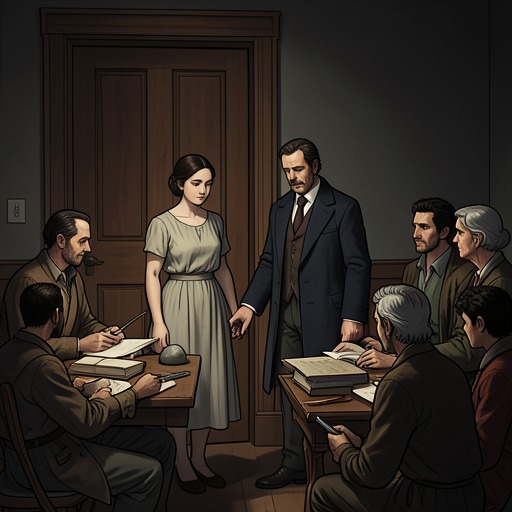
Lady Radha explains that the women who come to Grenadine Reef are usually servants or the daughters of tenants and tradesmen. They arrive after experiences that have left them needing both a place to stay and a way to deal with the consequences. Her own history gives the institution particular authority: she was kidnapped as a young woman and intended for sale into slavery, later suffered a pirate captain’s sword thrust through her womb, and survived an injury that was expected to be fatal. Her story is not presented as a simple claim that personal suffering automatically makes someone capable of healing others. Rather, it helps explain why she recognizes the vulnerability produced when women have little power over their bodies, movements, marriages, or reputations. Lady Radha’s method begins with testimony. When a woman first arrives, Lady Radha listens while she unburdens herself, speaks angrily about the unfairness of the world, or simply tries to make sense of what has happened. She does not judge or force a prescribed emotional response. This attention matters because the refuge treats speech as part of recovery: the women are not reduced to damaged bodies, inconvenient pregnancies, or compromised reputations, but are heard as people whose experiences require acknowledgment.
The Dower House and Its Operation
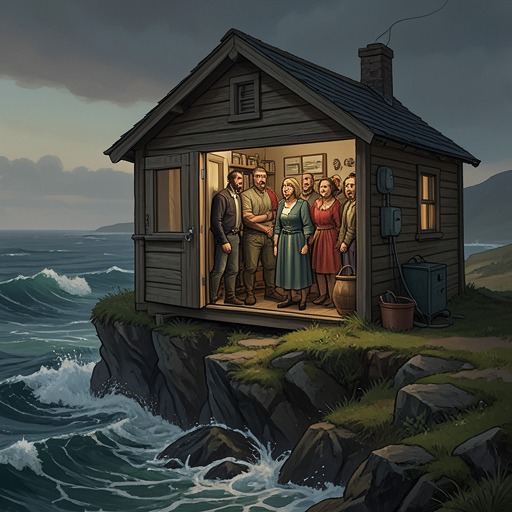
The women stay in the dower house, a separate and secluded building staffed entirely by females. It is self-contained, hidden from the main house and neighboring farms, and supplied through the Pentland estate. Mrs. Perkins, the housekeeper, visits twice each week, while Lady Radha visits when requested rather than arriving unexpectedly. As the lady of the manor, she understands that even a benevolent visitor can make residents anxious if she appears without warning; allowing them to prepare preserves a measure of control within a life already marked by coercion. The arrangement depends on the wider estate. Sir David manages Grenadine Reef so that it can feed the women and still produce a modest surplus for sale at market. Lady Radha corresponds with a select group of other ladies who help women move forward after leaving. The refuge therefore combines household management, agricultural production, correspondence, and emotional labor. Its work is sustained not by a single dramatic rescue but by recurring practical decisions about food, staffing, transport, money, and privacy. The model also exposes the gendered labor beneath a supposedly private country estate. Lady Radha’s responsibilities include listening, advising, coordinating, and preserving the refuge’s social boundaries, while Sir David’s estate management supplies the material base. The women’s recovery is supported by the same domestic and agricultural systems that sustain the household, but the refuge redirects those systems toward women who would otherwise have been left to bear the costs of male violence alone.
Recovery, Motherhood, and Self-Defence
The refuge does not demand that every survivor return to a former life. Some women go back into service; many return to farming or to their fathers’ trades. Others need a different course. If a woman becomes pregnant, she can remain at Grenadine Reef, have the child, and begin constructing a story for the future rather than being defined permanently by the circumstances of conception. Lady Radha states that more than three quarters of the women move beyond the experience and continue their lives. The statistic gives the refuge a clear practical measure of success, while also acknowledging that recovery is not universal. The women are taught to defend themselves. Most learn where to strike a man in order to escape his grasp, and some take the training further with the help of former sailors among the footmen, learning how to badly injure an attacker. This instruction is significant because the refuge does not rely solely on male protection. Sir David and the staff may provide safety within Grenadine Reef, but the women are also given bodily knowledge that can help them survive beyond its boundaries. Protection thus becomes preparation rather than permanent dependence. The institution’s approach differs sharply from the coercive logic surrounding Elizabeth Bennet’s refusal of William Collins. Elizabeth insists that a bride cannot be forced to marry and that she will not be sold for Longbourn. The refuge belongs to the same moral world: women’s welfare cannot be measured by whether they remain respectable, marry conveniently, or return quietly to male-controlled households. It recognizes that safety requires material options, privacy, knowledge, and the right to refuse.
Elizabeth Bennet’s Education and Inheritance
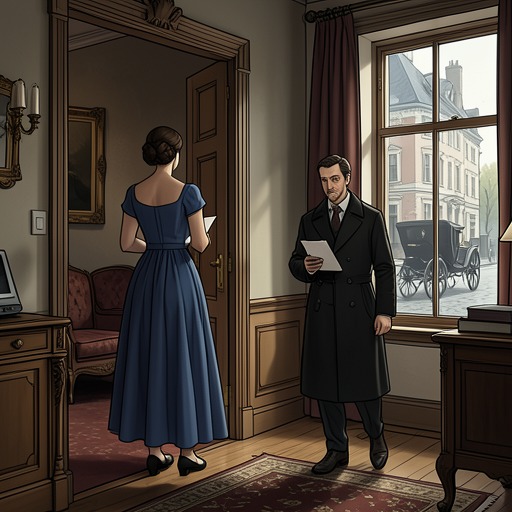
Elizabeth’s connection with Lady Radha gives the refuge a second life as an education in estate responsibility and social ethics. Elizabeth has no living grandparent who can occupy that role, and Lady Radha gradually becomes a grandmother-like figure while teaching her how to be the lady of an estate through conversation and shared experience rather than formal instruction. Elizabeth observes that Lady Radha is not merely setting menus: she is a helpmate to Sir David across the estate and a participant in decisions affecting people beyond the principal house. The lessons alter Elizabeth’s understanding of marriage and service. Seeing Lady Radha and Sir David remain devoted after more than thirty years, she comes to regard marriage as a partnership founded on love and daily cooperation rather than a transaction in property. Her visits to Grenadine Reef also improve the tenant visits she undertakes with Jane Bennet at Longbourn. Knowledge learned from the refuge makes those visits more efficient and more useful to tenants, because estate welfare is understood as the responsibility of the person who controls the estate rather than as decorative charity. Elizabeth’s education continues after she joins the Gardiner household. Madeline Gardiner teaches her the practical management of a house, including cleaning schedules, maintenance, and menu planning, while Edward Gardiner allows her to learn about his business. Elizabeth’s developing competence shows that care is not passive sentiment. It involves administration, budgeting, labor, judgment, and the ability to make institutions function. The refuge helps convert Elizabeth’s need to be busy and valued into a disciplined form of activity: she becomes, in her own phrase, calmly active. After Sir David’s death, Elizabeth insists that the dower house continue. She plans to consult Mrs. Perkins, Vivian Harkness, Violet Harkness, and the woman handling its daily organization, and she confirms that funding, food, provisions, and transport must remain in place. Her decision preserves the refuge as a genuine sanctuary rather than treating it as an incidental expense of the Pentland estate. The continuation is also a test of inheritance: the moral value of Grenadine Reef is measured not only by who owns it, but by what its resources continue to do for women without power.
Narrative and Social Significance
The refuge makes visible a social problem that polite society prefers to conceal. Abuse is not treated as an isolated private misfortune but as a recurring condition produced by women’s dependence and men’s impunity. The women who arrive are drawn from socially vulnerable groups, yet the system recognizes that class respectability offers no complete protection. Lady Radha’s own history crosses India, the Arabian Peninsula, Spain, the Caribbean, piracy, and Hertfordshire, linking the refuge’s local work to wider histories of forced movement, religious conflict, slavery, imperial violence, and bodily trauma. Its structure also contrasts with institutions that respond to women only after their reputations have become public problems. At Grenadine Reef, the women can recover away from the main house, make decisions about their next steps, keep or bear a child, learn to resist physical assault, and return to work or family trade. The refuge does not promise that the past can be changed; it offers conditions under which the future need not be dictated by it. The concept finally changes the meaning of estate power. The Pentland estate feeds the household, produces a surplus, and supports a network of female cooperation, but its deepest significance is distributive: land, labor, and inherited resources are used to create room for women who have been denied agency elsewhere. Refuge and recovery for abused women therefore joins feminist resistance to the practical economics of care. It is a protected place, but also a program of recovery, a school of self-defence, an apprenticeship in independence, and the clearest institutional legacy Lady Radha and Sir David leave behind.